Educational programming robot learning is a hands-on learning approach that combines hardware operation with software programming to cultivate logical thinking, creativity, and problem-solving skills, with its core principle being "learning by doing."
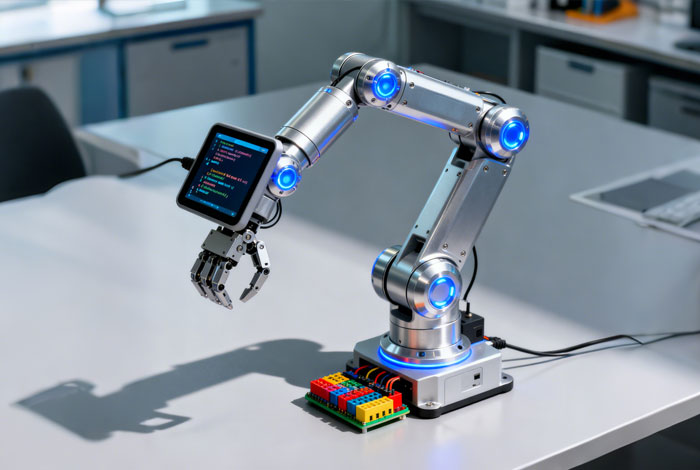
1. Learning Core Values
Cognitive Development: Break down complex tasks into steps to enhance logical and abstract thinking.
Skill Enhancement: Improve hands-on abilities and resilience by solving real-world problems through robot debugging.
Knowledge Integration: Combining mathematical (coordinates, angles), physical (mechanics, sensor principles), and programming knowledge to achieve interdisciplinary applications.
II. Phased Learning Pathway
Different age groups correspond to robots and programming methods of varying difficulty levels, eliminating the need to start from scratch with complex coding.
stage (ages 5-8): Block-based robots (e.g., LEGO WeDo), graphical programming, and simple mechanical structure building
Advanced Stage (Ages 9-12): Modular Robotics (e.g., Makeblock mBot) - Sensor Applications, Conditional Logic / Loop Programming
Professional Phase (Age 13+): Open-source hardware (e.g., Arduino/Raspberry Pi), coding (Python/C++), and custom feature development
III. Key Learning Recommendations
1. Start with Interest: Choose topics that excite children, such as having robots navigate mazes, dance, or complete tasks, avoiding rote knowledge transmission.
2. Emphasize the debugging process: Robot malfunctions are common, and guiding the analysis of issues (such as logical errors in code or hardware connection problems) is more important than providing direct solutions.
3. Combine with competition practice: Participate in youth robotics competitions (such as FLL, VEX) to enhance comprehensive abilities through teamwork and assess learning outcomes.