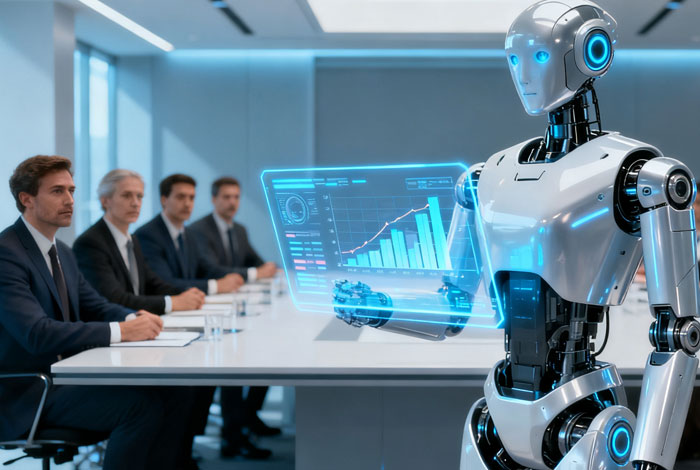
The Application of Business Meeting Robots
The core value of business meeting robots lies in enhancing the efficiency of the entire meeting process and reducing labor costs through automation and intelligence. Their applications cover the complete chain from pre-meeting preparation to post-meeting follow-up.
I. Core Application Scenarios
The applications of business meeting robots can be clearly divided according to meeting stages, and they address different core pain points in various scenarios.
1. Pre-meeting Preparation Stage
Agenda and Document Management: Automatically synchronize meeting topics, generate structured agendas, and distribute documents that participants need to read in advance (such as reports and draft contracts) to corresponding terminals based on permission settings.
Participant Organization: Integrate with calendar systems to automatically send meeting invitations (including time, location, and online links) to participants, count reply receipts in real time, and update the participant list simultaneously.
Equipment and Environment Preparation: Connect with conference room equipment (such as projectors, microphones, and air conditioners) to automatically complete equipment self-inspection and debugging before the meeting, ensuring that the environment and equipment are in usable condition when the meeting starts.
2. In-meeting Execution Stage
Real-time Recording and Transcription: Through speech recognition technology, convert meeting speeches into text minutes in real time, support real-time transcription in multiple languages, and automatically distinguish the identities of speakers (requiring pre-entry of participants' voice features).
Information Interaction and Assistance: Act as a "meeting assistant" to respond to participants' inquiries in real time (e.g., "retrieve last quarter's sales data," "repeat the key points of the previous discussion") or remind of the remaining time for the current agenda item based on the meeting agenda.
Decision Tracking: Automatically identify action items determined in the meeting, record the person in charge of the task and the deadline, and synchronize them to the to-do lists of relevant personnel to avoid omissions.
3. Post-meeting Follow-up Stage
Minutes Generation and Distribution: Without manual organization, structured minutes (including agenda items, discussion conclusions, and action items) can be generated within 10 minutes after the meeting ends and automatically sent to all participants.
Action Item Follow-up: Automatically send reminders to the persons in charge before the deadline of action items; if the items are not completed on time, notify relevant managers simultaneously to ensure the implementation of decisions.
Data Deposition and Analysis: Archive data such as meeting minutes, action items, and decision results into the enterprise knowledge base, and simultaneously analyze indicators such as meeting duration, agenda item efficiency, and action item completion rate to provide a basis for optimizing the meeting process.
II. Application Value and Advantages
Compared with the traditional manual handling of meeting processes, the core advantages of robots are reflected in three dimensions:
Efficiency Improvement: Improve the efficiency of time-consuming tasks such as pre-meeting document preparation and post-meeting minutes organization by more than 80%, allowing participants to focus on core discussions rather than transactional work.
Information Accuracy: The accuracy of speech transcription can reach more than 95% (customized vocabulary databases are required for professional fields), avoiding omissions or errors in manual recording and ensuring that meeting information is authentic and traceable.
Cost Savings: Reduce the labor input in positions such as meeting organization and minutes collation; at the same time, by optimizing meeting duration and following up on action items, reduce the hidden costs incurred by enterprises due to "inefficient meetings."
III. Typical Industry Application Cases
Internet technology, product requirement review meetings, and project retrospective meetings quickly synchronize cross-departmental requirements and accurately track project progress milestones.
Financial industry, financial industry risk control review meetings, quarterly performance meetings. Ensure compliance records (such as risk control decision basis) and efficiently consolidate business data.
Manufacturing: production coordination meetings and supply chain meetings, real-time synchronization of production line issues, and rapid assignment of cross-departmental collaboration tasks.