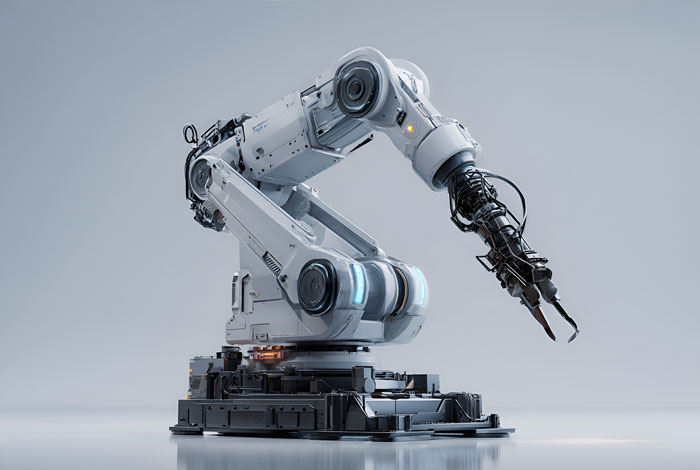
The core value of industrial mechanization lies in replacing manual labor with machinery to accomplish tasks that are highly repetitive, labor-intensive, and risky, thereby enhancing production efficiency, controlling costs, and ensuring stable product quality. Its application has permeated the core links of the entire industrial manufacturing chain.
I. Core application areas
The application of industrial mechanization can be divided according to production processes and types of operations, with different fields addressing different pain points in industrial production.
1. Processing and manufacturing field
Metal processing: Through the use of CNC machines, milling machines, grinding machines, and other equipment, precision processes such as cutting, grinding, and drilling of metal components are automatically completed, replacing traditional manual operations. The processing accuracy can be controlled at the level of 0.001mm.
Plastic/Rubber Molding: Utilizing machinery such as injection molding machines and extruders, raw materials are heated and molded according to set parameters, enabling the continuous production of large quantities of standardized products (such as home appliance casings and pipes), while avoiding errors associated with manual molding.
Assembly operation: Through automated assembly lines (such as the robotic arms in automobile production lines), the grasping, positioning, and assembly of components are completed, such as the welding of automobile chassis and body, and the insertion of electronic components, significantly enhancing assembly speed and consistency.
2. Material handling and warehousing field
In-plant material handling: Utilize equipment such as AGVs (Automated Guided Vehicles), forklifts, and overhead conveyors to replace manual handling of heavy materials (such as machine tool components and semi-finished products), enabling automatic material flow between various production processes within the workshop, thereby reducing labor costs and handling accidents.
Warehouse management: Through stacker cranes and automated three-dimensional warehouse systems, the warehousing, delivery, sorting, and storage of goods are automatically completed. High-level racks can be utilized to maximize warehouse space, and the system accurately records inventory to avoid errors and omissions in manual inventory counting.
Port/Logistics Transfer: Gantry cranes and container cranes are used at ports and terminals, while intelligent sorting machines are employed in logistics parks to achieve efficient loading, unloading, and classification of containers and parcels. The daily processing capacity can reach tens of thousands of items, far exceeding manual efficiency.
3. High-risk and special environment operation fields
Mine mining: Mining excavators, tunneling machines, belt conveyors, and other machinery are used to replace manual labor in underground or open-pit mining for ore extraction and transportation, avoiding safety risks such as collapses and dust poisoning.
Chemical production: Through enclosed mechanical reactors and automatic feeding equipment, the mixing, reaction, and transportation of chemical raw materials are completed in high-temperature, high-pressure, and corrosive environments, reducing the risk of manual exposure to harmful substances.
Building construction: Using equipment such as tower cranes, concrete mixing plants, and road rollers, to complete tasks such as lifting construction materials, preparing concrete, and compacting the ground, replacing manual high-altitude operations and heavy physical labor, and reducing the construction accident rate.
II. Application Value and Advantages
Compared to traditional manual production methods, the core advantages of industrial mechanization are concentrated in three dimensions:
Efficiency improvement: Mechanical operations can achieve 24-hour continuous operation, with production efficiency increased by 3-10 times compared to manual labor. For example, after mechanization of automobile production lines, the average daily production capacity of a single line can exceed 1,000 vehicles.
Cost optimization: In the long run, machinery can replace over 50% of repetitive manual labor positions, reducing labor costs. At the same time, it can reduce material waste caused by manual operations, and the utilization rate of raw materials can be increased by 10%-20%.
Quality and safety assurance: Mechanical operations are executed based on preset parameters, ensuring a stable product pass rate of over 99.5%. Furthermore, they are capable of handling high-risk tasks, reducing the industrial production accident rate by over 60%.
III. Typical Industry Application Cases
The differences in production characteristics across various industries determine the varying focuses of mechanization applications.
Automobile manufacturing: body welding, parts assembly, and complete vehicle inspection. Achieving standardized mass production, shortening production cycles, and ensuring consistency in vehicle quality.
Electronics and electrical appliances: Circuit board soldering (wave soldering equipment), product packaging (automatic sealing machine) to complete precision operations and avoid damage to electronic components caused by manual operations.
Food processing: Ingredient cleaning (high-pressure cleaning machine), filling and sealing (automatic filling machine), sorting (color sorter). It achieves hygiene standards in food production, avoids contamination from manual contact, and improves sorting efficiency.