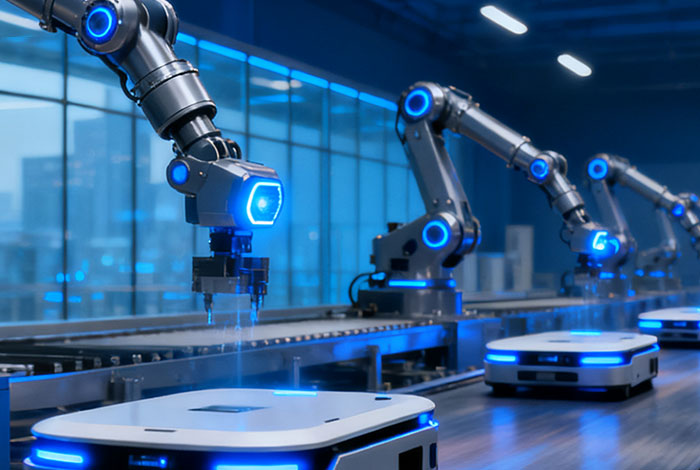
The core value of intelligent production lines lies in the integration of "automated equipment + data interconnection + AI decision-making", enabling autonomous optimization, flexible response, and quality traceability throughout the entire production process. This fundamentally distinguishes them from the traditional mechanized "single repetitive operation" mode.
I. Core application scenarios
The application of intelligent production lines spans the entire production cycle, addressing core pain points of traditional production through data loops in various scenarios.
1. Production execution stage
Flexible production scheduling: Automatically adjusting production parameters based on order requirements. For example, an automobile production line can quickly switch between welding and assembly procedures for different vehicle models on the same line without requiring manual re-debugging, reducing production changeover time by over 80%.
Autonomous collaboration of equipment: The robotic arms, AGVs, and machining tools within the production line are interconnected in real-time through the Industrial Internet of Things (IIoT). For instance, after the robotic arm completes the part grasping, it automatically notifies the AGV to deliver it to the next process, eliminating the need for manual transfer.
Process parameter self-optimization: The AI system collects production data (such as temperature, pressure, and cutting speed) in real-time, compares it with product quality results, and automatically fine-tunes process parameters. For example, in chip manufacturing, algorithms are used to optimize lithography accuracy and reduce the defect rate.
2. Quality control stage
Full-process visual inspection: Deploy AI visual inspection equipment at key nodes of the production line to replace manual labor in high-precision quality inspection, such as detecting the pin spacing of electronic components (with an accuracy of 0.01mm) and the sealing integrity of food packaging. The detection efficiency is improved by 5-10 times.
Quality issue tracing: By utilizing unique codes for each product (such as RFID or QR codes) to record production data (including equipment, time, operators, and raw material batches), in the event of a quality issue, it is possible to trace back to the specific link within 10 seconds and quickly identify the root cause.
Quality risk early warning: Based on historical quality data, a model is established. When there is an abnormal trend in production data (such as a continuous increase in the defective rate of products from a certain equipment), an early warning is automatically triggered, and the machine is shut down for maintenance in advance to avoid the production of batches of non-conforming products.
3. Equipment management stage
Predictive maintenance: Sensors collect real-time equipment operation data (vibration, temperature, energy consumption), and AI algorithms analyze the health status of the equipment to predict failure risks. For example, early warning of motor bearing wear can be issued 3 days in advance, avoiding sudden downtime (traditional reactive maintenance can lead to production line downtime for several hours).
Equipment efficiency optimization: Automatically calculate equipment OEE (Overall Equipment Effectiveness), analyze the reasons for downtime (such as material change, malfunction, and material waiting), and provide optimization suggestions, such as reducing equipment idle time by 20% by adjusting the raw material delivery schedule.
II. Application Value and Advantages
Compared to traditional production lines, the advantages of smart production lines are reflected in three core dimensions: "flexibility, efficiency, and controllability."
Enhanced flexibility: Quickly respond to order changes, achieving cost and efficiency close to mass production for small batches and multiple varieties, meeting the current market demand for "personalized customization".
Higher efficiency: The production cycle is shortened by 30%-50%, and the overall equipment effectiveness (OEE) is increased to over 85% (traditional production lines are usually below 60%), resulting in a significant increase in production capacity per unit time.
Enhanced controllability: With full-process data visualization, production progress, quality status, and equipment health can be checked in real-time. Managers can monitor remotely and intervene quickly, reducing the risks associated with "black box operations".
III. Typical industry application cases
The production characteristics of different industries determine the differences in the application priorities of smart production lines.
Electronic manufacturing: chip packaging and testing, circuit board mounting, and mobile phone assembly, achieving micron-level precision operations and solving the problem of rapid production change for multiple product models.
Automobile manufacturing: body welding, power battery assembly, complete vehicle assembly, improving production line flexibility, meeting mixed-model production of multiple vehicle types, and reducing the defect rate.
Medical devices: Implantable device processing, sterile packaging, quality traceability, meeting the strict quality standards of the medical industry, achieving full-process traceability.
Food and beverage: beverage filling, snack sorting, shelf life management, improving hygiene standards, and achieving rapid switching between different flavors/specifications of products.